
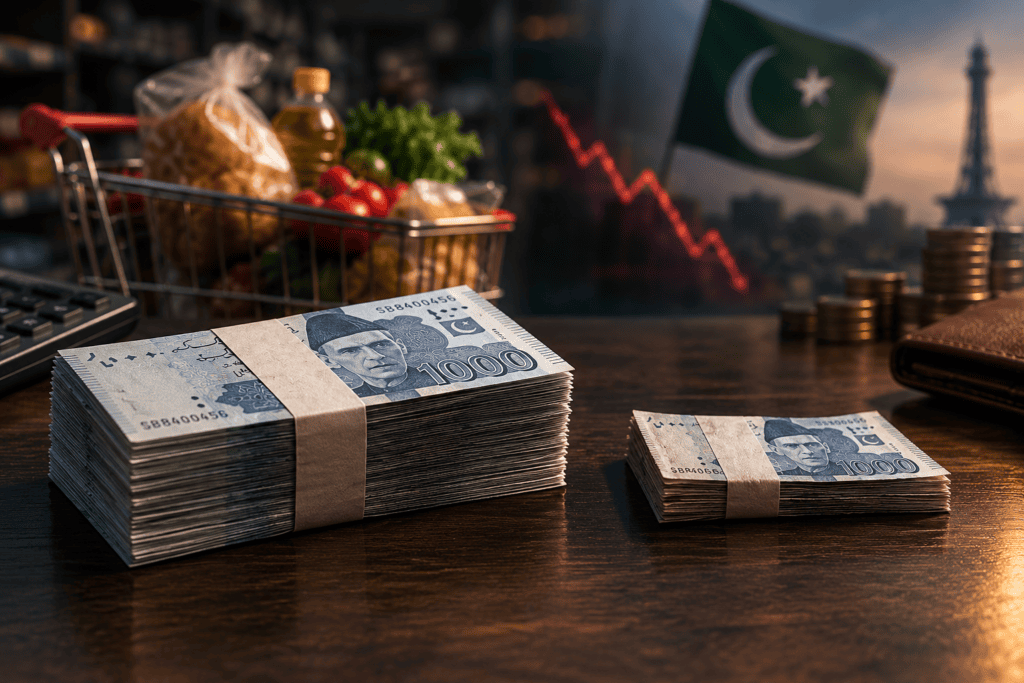
If your grandfather had put Rs 100,000 in a steel almirah in the year 2000 and you opened it this morning, you would still be holding ten crisp bundles of notes. Nothing stolen, nothing lost. And yet you would have been robbed of roughly 90% of what that money could do. That is what rupee purchasing power means in practice, and it is the single most expensive thing most Pakistani savers never calculate.
Pakistan’s Consumer Price Index stood at 29.88 in 2000. In 2026 it sits at 295.53. That is not a typo and it is not a slogan from a political speech. It is arithmetic: prices are now roughly 9.9 times higher than they were 26 years ago. This post walks through exactly what that did to cash, why a normal bank account did not save you, and what the best investment to beat inflation in Pakistan actually turned out to be over the same stretch.
Rupee Purchasing Power Since 2000: The Full Table
Take Rs 100,000 in the year 2000 and freeze it as cash. The table below shows what that same pile of notes could still buy at each five-year mark, measured in year-2000 rupees, using Pakistan’s official CPI series.
| Year | CPI (2015 = 100) | Rs 100,000 is really worth | Value lost |
|---|---|---|---|
| 2000 | 29.88 | Rs 100,000 | — |
| 2005 | 38.39 | Rs 77,800 | 22% |
| 2010 | 68.83 | Rs 43,400 | 57% |
| 2015 | 100.00 | Rs 29,900 | 70% |
| 2020 | 137.72 | Rs 21,700 | 78% |
| 2025 | 275.68 | Rs 10,840 | 89% |
| 2026 | 295.53 | Rs 10,100 | 90% |
Flip the same calculation around and it becomes even more uncomfortable. To buy today what Rs 100,000 bought in 2000, you would need about Rs 989,000. Nearly ten lakh rupees to replace one lakh.
The average works out to roughly 9.2% compound inflation per year over 26 years. Apply the rule of 72 to that number and you get something worth memorising: at this pace, the purchasing power of idle cash halves roughly every eight years. Money you are “keeping safe” for your children’s education is losing half its usefulness twice before they finish school.
Why the Rupee Lost 90% of Its Value
This was not one disaster. It was a slow grind with three violent episodes layered on top.
- 2008-2010: the global commodity and food price shock, which pushed Pakistani inflation above 20% in 2008 and kept it in double digits for three straight years.
- 2019-2021: a currency adjustment and energy tariff cycle that kept CPI near 10% even before the pandemic supply squeeze.
- 2022-2024: the worst of it. Inflation peaked above 30%, and the CPI index nearly doubled from 192 to 266 in roughly two years. Almost a third of the entire 26-year erosion happened in that one window.
That last point matters more than it looks. Inflation is not a steady tax you can plan around. It is quiet for years and then takes a decade’s worth of value in twenty-four months. Anyone who was sitting in cash in 2021 because “the market looked risky” discovered this the hard way.
The Bank Account Trap
The obvious objection is: nobody keeps a lakh in an almirah, they keep it in a bank. Fair. So let us run that version.
A conventional Pakistani savings account has paid somewhere around 5-7% on average across these 26 years, depending on the bank and the period. Take the middle of that range, 6%, and compound it. Rs 100,000 becomes roughly Rs 455,000 by 2026.
Now compare that to the Rs 989,000 you needed just to stand still. The bank account did not protect you. It lost you more than half your purchasing power, slowly enough that the rising number in your passbook made it feel like progress.
This is still happening right now, not just in history. Pakistan’s CPI inflation came in at 10.3% year-on-year in September 2026, according to Business Recorder’s report on the PBS release, with the Q1 FY27 average at 10.2%. A savings account paying 8-9% against that is a guaranteed real loss, every single month, with no volatility to warn you it is happening. We covered the mechanics of this squeeze in detail in our breakdown of the Pakistan inflation rate for August 2026.
What Actually Beat Inflation in Pakistan
Here is the same Rs 100,000 from 2000, put into five different places, valued in October 2026.
| Where you put it | Value in Oct 2026 | Multiple | Beat inflation? |
|---|---|---|---|
| Cash at home | Rs 100,000 | 1.0x | No — lost ~90% |
| Bank savings (~6% avg) | ~Rs 455,000 | 4.6x | No — lost ~54% |
| Break-even bar (inflation only) | Rs 989,000 | 9.9x | This is the hurdle |
| Gold (per tola) | ~Rs 7.0 million | ~70x | Yes, comfortably |
| KSE-100 (price index) | ~Rs 10.9 million | ~109x | Yes, the most |
The gold figure comes from a tola price of roughly Rs 6,150 in 2000 against about Rs 432,500-435,400 per tola in October 2026. Rs 100,000 would have bought about 16.3 tola in 2000.
The equity figure uses the KSE-100 at 1,507.59 at the close of 2000 against roughly 164,800 in October 2026 — a 109-fold move in the index itself, before any dividends are counted.
Read the caveats honestly. Gold returns here exclude making charges, purity spreads and the cost of safe storage. The KSE-100 is a price index, so it ignores dividends in your favour but also ignores brokerage, capital gains tax and the fact that almost nobody actually holds an index untouched for 26 years. Both numbers are also backward-looking. They tell you which asset classes have historically outrun Pakistani inflation; they are not a forecast that the next 26 years will repeat.
Best Investment to Beat Inflation in Pakistan Right Now
History is useful, but you can only invest in the present. With inflation at 10.3% and the State Bank policy rate held at 11.5%, here is where the realistic options sit in October 2026.
| Option | Indicative return | Real return vs 10.3% | Liquidity | Main risk |
|---|---|---|---|---|
| Savings account | ~8-9% | Negative | High | Guaranteed slow loss |
| National Savings certificates | ~11-13% | Slightly positive | Low (lock-in) | Rates reset with the policy cycle |
| Treasury bills | ~11-12% | Roughly flat to positive | Medium (3-12 months) | Yields move with rate expectations |
| Gold | Tracks global price + PKR | Historically strongly positive | Medium-high | Sharp short-term swings |
| PSX equities | Market-dependent | Historically the highest | High | Real drawdown risk; needs patience |
| Rental property | ~6-7% yield + capital growth | Yield alone lags | Very low | Illiquid; yields now below the policy rate |
Notice the pattern. The two instruments that merely keep pace — savings certificates and T-bills — require you to lock money up, and they only work while the policy rate stays above inflation. The moment the SBP starts cutting rates, that thin positive real return disappears while inflation keeps running.
If you want to compare the fixed-income options properly before committing, our guide to the best savings certificate in Pakistan lays out the current rates, tax treatment and lock-in terms side by side. On the property side, be aware that Karachi rental yields have fallen to 6.67%, below both inflation and the policy rate, which changes the maths on buy-to-let considerably.
What This Means for Pakistani Investors
Three practical takeaways come out of the numbers above.
First, cash has a cost and it is about 10% a year. You still need an emergency fund — three to six months of expenses, liquid, no exceptions. But every rupee beyond that buffer sitting idle is paying a tax you never see on a statement. Size your cash deliberately rather than by default.
Second, your salary is not inflation-protected either. If your income rose 7% this year and prices rose 10.3%, you took a 3.3% pay cut regardless of what the appraisal letter said. The same CPI that eats savings eats earnings, which is why building an asset base outside your job matters more in Pakistan than in a low-inflation economy.
Third, concentration cuts both ways. Gold and equities beat inflation over 26 years, but neither did it smoothly. Gold went nearly nowhere in real terms between 2012 and 2018. The KSE-100 has had multiple 30%+ drawdowns inside that 109x journey, including a sharp pullback from record highs in 2026. The sensible structure is a mix — liquid buffer, a fixed-income sleeve that tracks the policy rate, and a long-horizon allocation to real assets — rather than a bet on whichever one looks best in a table.
FAQs: Rupee Purchasing Power in Pakistan
How much value has the Pakistani rupee lost since 2000?
Measured by CPI, roughly 90%. The index rose from 29.88 in 2000 to 295.53 in 2026, meaning prices are about 9.9 times higher. Rs 100,000 of year-2000 money now buys what about Rs 10,100 bought then.
How much would I need today to match Rs 1 lakh from 2000?
About Rs 989,000 as of 2026, based on the official CPI series. The figure rises every month that inflation stays positive.
Does a bank savings account protect against inflation in Pakistan?
Historically, no. At a long-run average of around 6%, Rs 100,000 from 2000 would be roughly Rs 455,000 today, against the Rs 989,000 needed just to break even. At current rates of 8-9% against 10.3% inflation, ordinary savings accounts are still losing real value.
What is the best investment to beat inflation in Pakistan?
Over the last 26 years, PSX equities and gold both comfortably outran CPI, while cash and plain savings accounts did not. There is no single answer for every household, and past performance is not a guarantee. For most savers, a blend of a liquid buffer, policy-rate-linked instruments and a long-term allocation to gold or equities is more defensible than concentrating in any one of them.
How fast does inflation halve my money in Pakistan?
At the 26-year average of about 9.2% a year, idle cash loses half its purchasing power in roughly eight years. At the current 10.3% rate, it is closer to seven.
The Bottom Line
The scariest chart in Pakistani personal finance is not a crashing stock index. It is a straight, flat line labelled “cash,” plotted against a CPI that went up tenfold. Rupee purchasing power fell about 90% between 2000 and 2026, and the people who lost the most were not the ones who took risk — they were the ones who thought they were being careful.
You do not need to become a trader. You do need to make sure that every rupee you are not planning to spend in the next six months is sitting somewhere that at least has a chance of outrunning a 10% CPI. Doing nothing is not the neutral option. It is a decision to lose roughly half your money every eight years.
This article is for information only and is not personalised financial advice. Returns quoted are historical and do not predict future performance. Consider your own circumstances, or speak to a licensed adviser, before investing.
Leave a Reply