
AI chip stocks crash 2026 numbers are hard to ignore: more than $1 trillion in market value vanished from the world’s biggest AI and semiconductor companies in a single week, and the sell-off is still running. Nvidia, AMD, Dell, SK Hynix, Samsung and SoftBank all fell sharply on October 15, 2026, dragging the Nasdaq Composite down with them.
If you hold any international AI exposure, through a US brokerage account, a global tech fund, or even just a watchlist you check every morning, this is the week that tests your conviction. Here is exactly what happened, why it happened, and what it actually means if you are investing from Pakistan.
This is not the first AI correction scare of 2026. A similar wobble in August proved short-lived within weeks. What makes this one different is that the warnings came first, from the people actually building the industry, and the sell-off followed almost exactly on schedule.
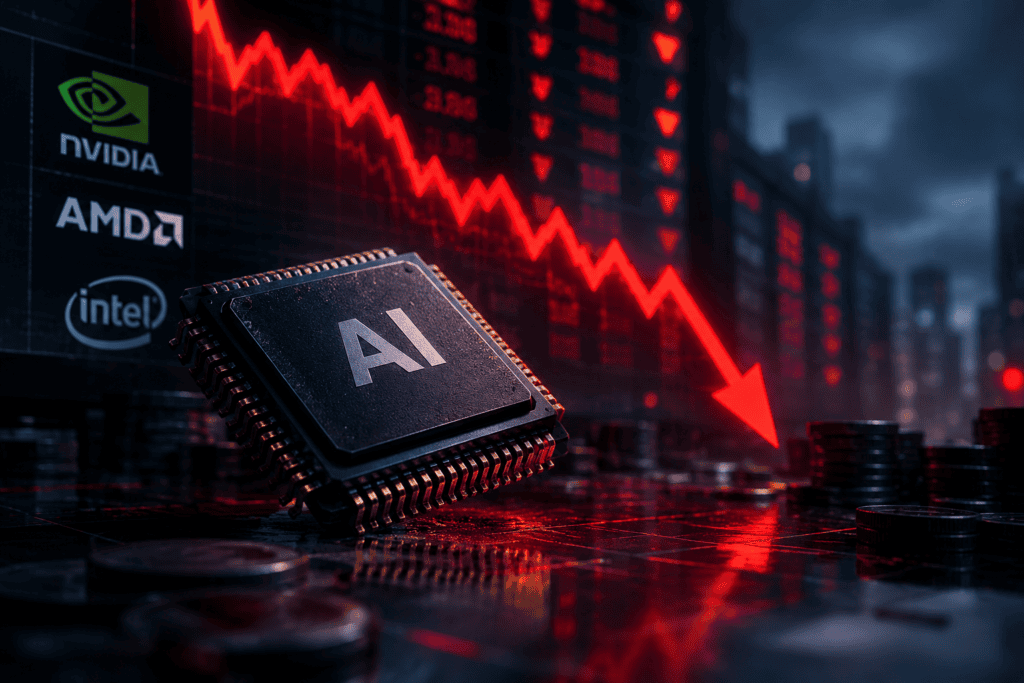
The AI Chip Stocks Crash 2026 in Numbers (October 15)
The damage was broad and fast. According to CNBC’s reporting, premarket US trading on October 15 showed Nvidia down 1.8%, AMD down 3.5%, Micron down 4.4% and CoreWeave down 5.3%. Oracle and Nebius also slipped. The sharper shock came from Asia, where South Korea’s SK Hynix fell more than 10%, Samsung Electronics dropped 8.73%, and Japan’s SoftBank Group lost 7.9%. Chip equipment maker Advantest fell almost 14%.
Europe was not spared either. The Netherlands’ ASML dropped 6.6%, and Germany’s Infineon fell 9.4%. By Wednesday, the broader market had already cracked, with the Nasdaq Composite down 1.88% to 26,692.87 and the S&P 500 down 1.11%, after hotter-than-expected US inflation data.
| Company (Market) | Approx. Move, Oct 15 2026 |
|---|---|
| Nvidia (US) | -1.8% |
| AMD (US) | -3.5% |
| SK Hynix (South Korea) | -10%+ |
| Samsung Electronics (South Korea) | -8.73% |
| SoftBank Group (Japan) | -7.9% |
| Advantest (Japan) | -14% |
| ASML (Netherlands) | -6.6% |
Taken together, the AI chip stocks crash 2026 saw roughly 20 of the world’s largest AI and semiconductor stocks lost more than $1 trillion in combined market value in a matter of days, based on CNBC’s analysis of the rout.
Why the AI Chip Stocks Crash 2026 Happened
Rising Interest Rates Make AI’s Bills More Expensive
The immediate trigger for the AI chip stocks crash 2026 was boring but powerful: hotter-than-expected US inflation data pushed Treasury yields above 5%, reviving fears that the Federal Reserve is not done raising rates. That matters enormously for AI, because the entire boom runs on borrowed money for data centers, chips and electricity.
Two CEOs Said the Quiet Part Out Loud
Two days before the rout, at a Singapore event on October 13, Broadcom CEO Hock Tan compared AI investors to gamblers, saying “a lot of investors have no clue what they are investing in” and that some “set very extreme expectations only to find out that it’s almost like they are in a casino.” Intel’s CEO echoed him on the same panel, warning that a shortage of capital, not chips, could become the AI industry’s real bottleneck. Tan pointed to Firmus, an AI data center company that pulled its IPO in the first week of October, as an early sign of financing strain.
We flagged a version of this exact risk in our coverage of the Broadcom Anthropic circular financing deal and the AI infrastructure funding boom, where chip suppliers are also acting as lenders to their own customers. This week’s crash looks like the market finally pricing in what that structure implies: AI demand numbers that are partly funded by the sellers themselves, not pure end-customer appetite.
A Possible Memory Chip Glut by 2029
Adding to the nerves, analysts are warning that memory chip makers have expanded capacity so aggressively that a supply glut could hit by 2029, which would hurt the same companies now racing to build it. China’s ChangXin Memory Technologies also said it had developed a new DRAM architecture that could sharply increase memory density, adding competitive pressure from a country investors had assumed was years behind.
Bull Case vs Bear Case: Is This a Buying Opportunity?
Not every analyst reads the AI chip stocks crash 2026 as the end of the AI trade. Dan Ives of Yorkville Ives called the pullback a “financing question, not a demand question,” arguing the AI infrastructure boom is still early and that this dip could turn out to be a buying opportunity.
| Bull Case | Bear Case |
|---|---|
| AI compute demand remains strong; this looks like a financing wobble, not a demand collapse | Vendor financing and circular deals mean reported demand may be partly artificial |
| Rate fears could ease once inflation data cools | Treasury yields above 5% make $100B+ data center bets much costlier to finance |
| A $1T+ repricing in days reflects real risk being priced in, not just noise | A string of IPO pullbacks, like Firmus, suggests funding is already tightening |
Ives named his own warning signs to watch: cuts to hyperscaler capital spending, canceled data center contracts, or falling GPU rental prices. None of those has happened yet, but if they do, this week’s dip stops being a buying opportunity and starts being a correction.
What the AI Chip Stocks Crash 2026 Means for Pakistani Investors
None of the companies at the center of the AI chip stocks crash 2026, Nvidia, AMD, SK Hynix, Samsung or SoftBank, are listed on the Pakistan Stock Exchange. Most Pakistani investors can only access them through an international brokerage account, a global ETF, or indirectly through mutual funds that hold foreign equities. If you hold any of those, this week’s move will already be sitting in your statement.
If you are chasing the best investment in AI stocks from Pakistan, the honest answer right now is that the easy-money phase of this trade is over. Entry points matter again, and so does checking how much of a fund’s “AI exposure” is genuine chip or software revenue versus vendor-financed deals like the one we covered in our Broadcom Anthropic circular financing deal report, or the valuation questions raised around Anthropic’s own IPO plans.
There is also a local echo worth watching. Our KSE-100 Rebound After Fed Hike coverage showed how global rate moves ripple into PSX sentiment, even though Pakistani tech names are a small slice of the index. A sustained global tech rout tends to pull risk appetite down everywhere, including Karachi, even where the exposure is indirect.
How to Protect Your Portfolio Right Now
You do not need to panic-sell every time an AI chip stocks crash makes headlines. A few checks are worth doing this week before you touch anything:
- Check your actual exposure. Add up how much of your portfolio sits in US tech, AI, or semiconductor names, directly or through a fund, before deciding anything.
- Separate financing risk from demand risk. Falling GPU rental prices or canceled contracts would be a real warning sign; a one-week price drop on rate fears is not the same thing.
- Avoid adding new money into a single AI stock this week. If you want exposure, a broad-based global tech or semiconductor fund spreads the risk of any one circular-financing deal unraveling.
- Watch Treasury yields, not just stock prices. As long as yields sit near or above 5%, expect this volatility to continue.
- Don’t confuse Pakistani and global tech exposure. A PSX-listed technology name is not directly exposed to Nvidia’s or Broadcom’s balance sheets, even when sentiment spills over.
Frequently Asked Questions
Why did AI chip stocks crash in October 2026?
The AI chip stocks crash 2026 was driven by a combination of hotter-than-expected US inflation data, which pushed Treasury yields above 5%, and warnings from Broadcom and Intel’s CEOs that financing, not chip supply, could become AI’s biggest constraint. Roughly 20 major AI and semiconductor stocks lost more than $1 trillion in value in a single week.
Is the AI bubble bursting?
Not according to most analysts, including Dan Ives, who called this a financing concern rather than a sign that AI demand is collapsing. The real warning signs to watch are cuts to hyperscaler spending, cancelled data center contracts, or falling GPU rental prices, none of which have happened yet.
Can Pakistani investors buy Nvidia or Broadcom stock directly?
Only through an international brokerage account or a global fund with US equity exposure, since neither company is listed on the Pakistan Stock Exchange.
Is this the best investment in AI stocks for Pakistani investors right now?
It depends on your risk tolerance and time horizon. The sell-off has made entry points more attractive than a month ago, but the financing risk highlighted by Broadcom and Intel’s CEOs has not gone away, so this is not a moment for an all-in bet.
The AI chip stocks crash 2026 does not settle the AI bubble debate either way. What it does confirm is that the easy, one-directional run in AI stocks is over, and that financing, not chip supply, is now the number worth watching before you buy the dip. Keep an eye on hyperscaler spending plans over the next few weeks; they will tell you far more than any single day’s headline.
Written by the Best Investment editorial team, tracking Pakistan’s gold, crypto, real estate and stock markets daily. Have a correction or question? Contact us.
Sources: CNBC, “Global tech rout, AI funding worries” (October 15, 2026); 247wallst.com, “Broadcom’s CEO Just Compared AI Investors to Gamblers” (October 13, 2026); South China Morning Post on CXMT’s DRAM architecture.
[…] semiconductor stocks lost more than $1 trillion in value that week. Read our full coverage of the AI chip stocks crash 2026 for what happened and […]
[…] and it is worth being precise about why, because the two episodes are not the same story. Our coverage of the October 15 AI chip stocks crash traced that selloff to macro fear: hotter-than-expected inflation data pushed Treasury yields above […]
[…] We covered the scale of that dependence when the sector sold off in October, in our look at the AI chip stocks crash of 2026, and when Nvidia committed to the OpenAI data centre […]